Squid Game:
Childhood Games in a Debt Economy
by Vera Von Monika
There are stories that imagine dystopia as a future event, and others that reveal it as a present condition. Squid Game belongs firmly to the latter. Conceived and directed by Hwang Dong-hyuk, the series does not speculate about what society might become… it exposes what it already is. Its cruelty is not exaggerated, it is systematized. Its violence is not chaotic, it is procedural. And its setting is not an abstract nowhere, but contemporary South Korea, rendered with uncomfortable clarity.
Released globally on Netflix, Squid Game transformed a distinctly Korean social critique into a shared international reference point without softening its local specificity. What travels is not spectacle, but structure.
At its core, Squid Game is a story about debt - not only financial, but moral, emotional, and social. The participants are not villains or outliers. They are workers, migrants, failed entrepreneurs, former students, caregivers. People who did what they were told, followed the rules, trusted the system, and still collapsed beneath it. Their presence in the game is not a moral failing, but a structural consequence.
The genius of Squid Game lies in its framing. Rather than inventing futuristic trials or elaborate fantasy mechanisms, it returns to children’s games - activities embedded in collective memory. 무궁화 꽃이 피었습니다 (Red Light, Green Light). 줄다리기 (Tug of War). 구슬치기 (Marbles). 징검다리 건너기 (the Glass Bridge). And finally, 오징어 게임 (the Squid Game) itself. These are not symbolic in a vague sense; they are culturally precise. They recall a shared childhood, a time before rankings, before interest rates, before resumes and credit scores. By resurrecting these games, the series stages a brutal contrast: a society that begins in equality and ends in extraction.
Even before the games begin, the series establishes its moral logic through 딱지 (ddakji) - a traditional Korean paper-flipping game used as recruitment. Played casually in public spaces, it disguises humiliation as play and debt as choice. The game is harmless in itself, yet it introduces the central lie of the system: that participation is voluntary, and loss is personal.
Each game functions as a social lesson disguised as entertainment. Red Light, Green Light introduces the premise with chilling efficiency: stop too late, and you are eliminated. There is no appeal, no reinterpretation, no mercy. Compliance is survival. Movement is risk. The rule is simple, and therefore unforgiving. This establishes the moral architecture of the series: fairness of rules does not guarantee fairness of outcomes.
Tug of War, one of the most revealing sequences, reframes physical weakness as strategic vulnerability. Strength alone fails. Survival depends on hierarchy, obedience, and collective discipline. The elderly participant’s instructions matter not because of wisdom alone, but because the group accepts authority without question. The scene mirrors corporate and institutional structures where survival depends on knowing when to pull, and when to submit.
Marbles marks the emotional rupture of the series. Paired intimacy becomes a liability. Trust is weaponized. The rules appear benign, even gentle, until their consequences unfold. Here, Squid Game reveals its most devastating truth: under conditions of scarcity, morality becomes negotiable. Not because people are evil, but because systems demand sacrifice. Friendship does not dissolve due to betrayal, it collapses by design.
The glass bridge offers the illusion of choice. Each participant may step forward, but only one survives each decision. Risk is individualised, while the structure remains intact. Those behind benefit from the sacrifice ahead, a precise visualization of how modern economies distribute danger unevenly while preserving the myth of personal responsibility.
What distinguishes Squid Game from generic survival narratives is its refusal to psychologize failure. The series does not ask why individuals made bad choices, it asks why those choices were inevitable. South Korea’s well-documented struggles with household debt, precarious employment, and relentless competition form the unspoken backdrop. The characters’ desperation is not melodramatic - it is familiar.
Equally important is the presence of the VIPs. They are not monsters, they are spectators. Detached, bored, global. Their language is foreign, their interest fleeting. They do not create the system - they consume it. This is one of the series’ sharpest critiques: suffering has become a form of content. Violence, when properly framed, is entertainment. The players’ deaths are not tragedies, they are outcomes.
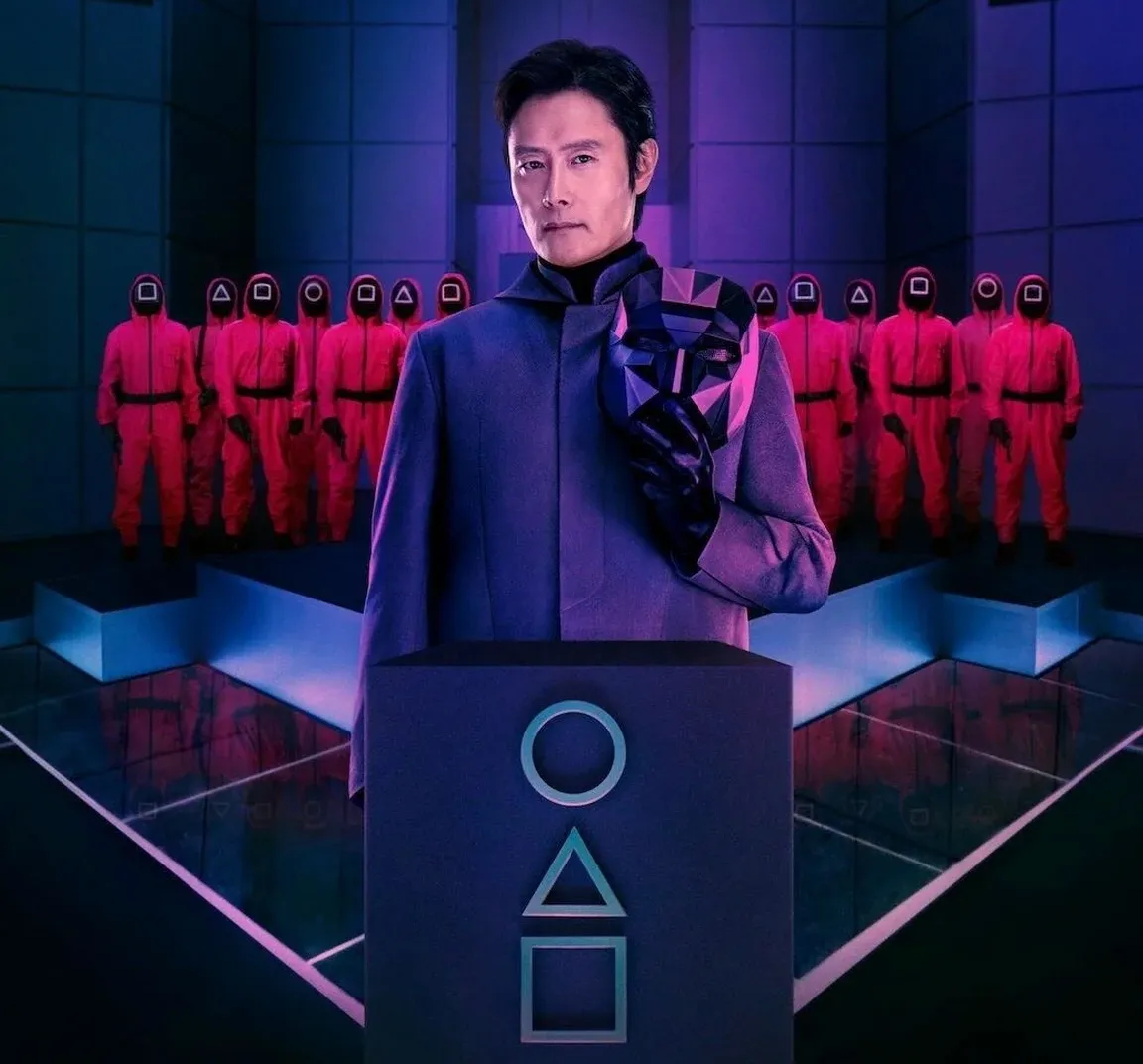
And yet, the most unsettling figure is not among the VIPs, but within the system itself. The Front Man, portrayed by Lee Byung-hun, embodies institutional loyalty - someone who understands the cruelty and enforces it anyway. His silence is not ignorance, it is alignment. In this sense, Squid Game speaks directly to a broader cultural anxiety: how many people sustain unjust systems not out of malice, but out of professional duty?
Despite its global success, Squid Game remains distinctly Korean in its emotional economy. Silence carries weight. Shame operates beneath dialogue. Masculinity is defined not through dominance, but endurance. Emotional incarceration is not weakness, it is survival. The series does not explain itself excessively. It trusts the audience to recognise the cost of compliance.
Importantly, Squid Game does not offer catharsis. Winning does not redeem the system. Survival does not restore innocence. The prize money, once desired, becomes unbearable - a monument to accumulated loss. The final episodes resist triumph. They linger instead on the impossibility of returning to neutrality once one has seen how the game works.
This is why Squid Game resonated globally without diluting its specificity. Its language is Korean, but its structure is universal. It exposes a condition familiar across contemporary societies: the promise that if rules are followed closely enough, safety will follow. The series dismantles that promise with precision.
Ultimately, Squid Game is not about games. It is about the erosion of social trust. It asks a question that lingers long after the final scene: what happens when survival requires participation in a system you know is unjust, and refusal is no longer an option?
In presenting childhood games as instruments of adult collapse, Squid Game delivers its most devastating insight: the cruelty of the system is not that it breaks the rules, but that it follows them perfectly.
Author’s Note
This feature approaches Squid Game as a work of cultural critique rather than genre entertainment, examining how childhood games, debt, and institutional design reflect contemporary South Korean social structures. The analysis focuses on narrative framing, symbolic use of play, and the series’ treatment of morality under systemic pressure, situating the work within a broader conversation about modern economies, spectatorship, and survival.
 @vera.von.monika
 @veravonmonika
 Livedoor