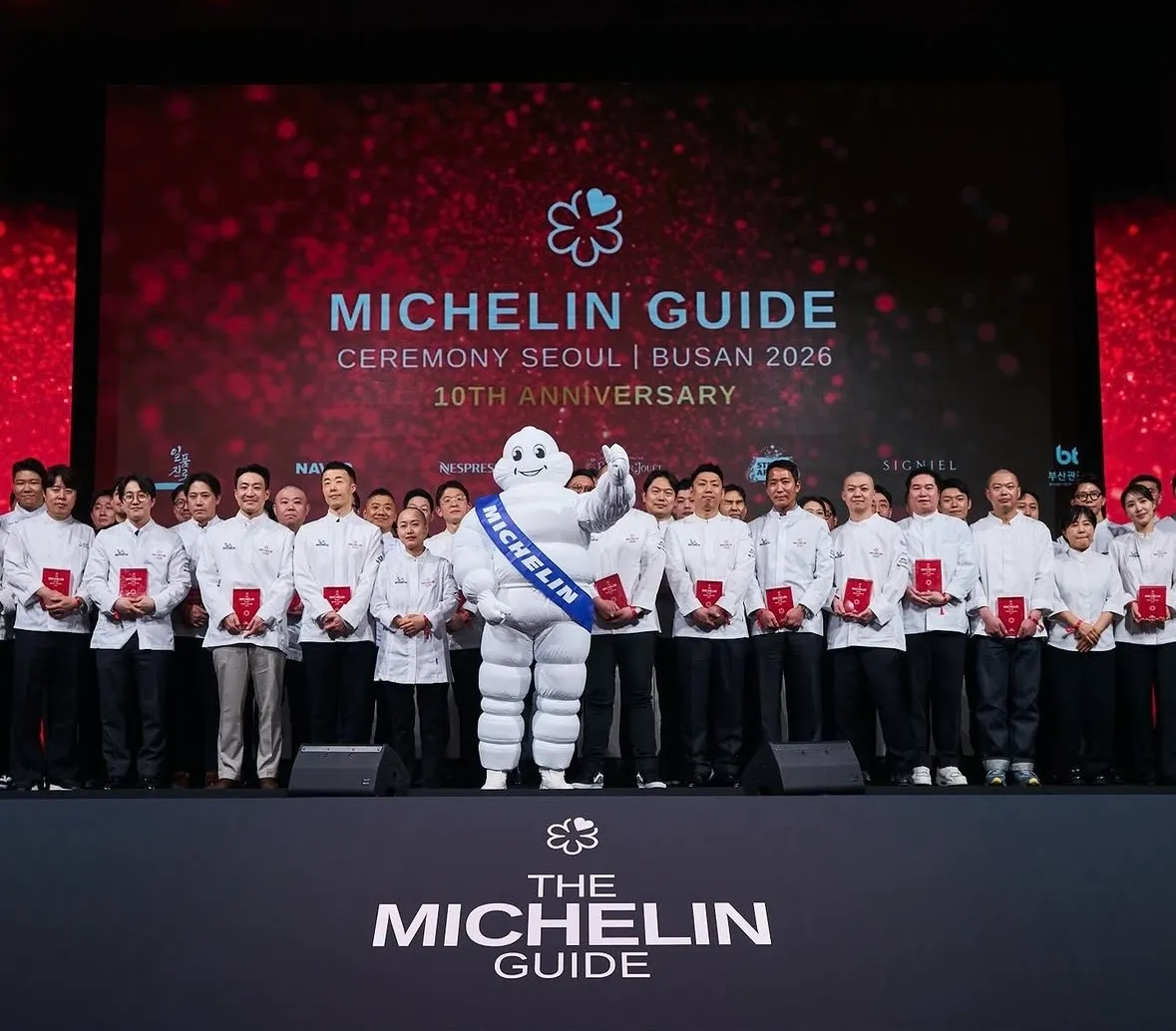
A Decade of Flavor: The MICHELIN Guide Seoul & Busan 2026
Seoul, South Korea
5 March 2026
by Vera Von Monika
When the Michelin Guide first arrived in Seoul in 2016, it marked a turning point for South Korea’s culinary identity. What had long been a vibrant domestic food culture was suddenly placed under the international spotlight of one of gastronomy’s most influential institutions.
Yet the significance of that moment was not simply recognition. It marked the beginning of a structural shift: Korean cuisine moving from a national culinary tradition toward a globally interpreted gastronomic language.
A decade later, the MICHELIN Guide Seoul & Busan 2026 reads not merely as a list of restaurants, but as a portrait of a dining culture that has matured into one of the most compelling in Asia.
The new edition includes 233 restaurants across Seoul and Busan, reflecting the scale and diversity of Korea’s contemporary gastronomic landscape. From refined reinterpretations of traditional cuisine to modern tasting menus that merge local ingredients with contemporary technique, the guide illustrates a country whose culinary narrative continues to evolve.
At the summit of the guide stands Mingles, which retains Korea’s only three Michelin stars. Under the direction of chef Kang Min-goo, the restaurant has become emblematic of modern Korean haute cuisine.
What distinguishes Mingles is not merely technical precision but its reinterpretation of Korean culinary structure itself. Fermentation -long central to Korean food culture - appears in refined forms, while traditional ingredients such as jang, seasonal herbs, and regional produce are reconstructed through contemporary tasting menus. The result is a cuisine that remains recognizably Korean while operating within the broader language of fine dining.
Yet the story of the 2026 guide extends far beyond the highest tier of the Michelin constellation. New promotions and recognitions highlight the dynamism of the country’s culinary ecosystem, with several restaurants earning their first stars and others ascending to higher distinctions.
One of the most closely watched developments this year is the return of Mosu Seoul, which regained two Michelin stars following its reopening in a new location. Under the leadership of chef Ahn Sung-jae, the restaurant’s reappearance signals both resilience and continued influence within Korea’s evolving fine-dining landscape.
Mosu has long occupied a distinctive position within modern Korean gastronomy. Its approach combines Korean ingredients with the architecture of contemporary tasting menus more commonly associated with global fine dining. The restaurant’s return therefore represents more than a reopening; it reflects the growing confidence of Korean chefs in presenting their cuisine through international culinary frameworks while retaining cultural specificity.

Among the establishments attracting attention is GiwaKang, newly awarded a Michelin star. The restaurant’s success also brought recognition to sommelier Lee Jung-in, recipient of the guide’s Sommelier Award for his thoughtful and precise wine pairings - an acknowledgment that the experience of fine dining increasingly depends on collaboration across the dining room as much as the kitchen.
Meanwhile, the guide continues to highlight emerging talent shaping the future of Korean gastronomy. The Young Chef Award was presented to Kim Chang-wook, reflecting Michelin’s attention to a new generation of culinary voices redefining how Korean cuisine is interpreted and presented.
The 2026 edition also introduced a new distinction celebrating the energy of newly opened restaurants. The Opening of the Year Award was presented to chef An Lee for the restaurant IAán, highlighting how new culinary ventures continue to reshape the city’s gastronomic identity.
If Seoul remains the beating heart of the country’s fine-dining scene, Busan’s growing presence in the guide signals a broader geographic shift. The coastal metropolis, long celebrated for its seafood markets and maritime culture, now counts several Michelin-recognized restaurants of its own.
This evolution is not accidental. Busan’s culinary identity differs significantly from Seoul’s: where the capital’s restaurants often reinterpret royal cuisine or temple traditions, Busan’s emerging fine-dining culture draws heavily from its proximity to the sea. Seasonal seafood, regional ingredients, and a strong market culture increasingly influence tasting menus that reflect the city’s maritime heritage.
Together, these developments illustrate a broader transformation within Korean cuisine. Once viewed internationally through a relatively narrow lens - often reduced to dishes such as kimchi, barbecue, or street food - it now operates within a far more complex gastronomic ecosystem.
Fermentation techniques refined over centuries, regional ingredients, and a strong sense of seasonality remain central. Yet chefs are increasingly interpreting these traditions through contemporary culinary dialogue, blending classical Korean foundations with modern technique and presentation.
Ten years after Michelin’s arrival in Korea, the guide has therefore become more than a ranking system. It functions as a record of a culinary culture undergoing rapid evolution, one in which tradition, innovation, and international influence intersect.
If the first decade of the Michelin Guide in Korea marked the country’s arrival on the international gastronomic stage, the next may well reveal something more ambitious: a cuisine no longer adapting to global fine dining, but actively redefining it.
Author’s Note
This feature examines the cultural and gastronomic significance of the Michelin Guide’s 2026 selection for Seoul and Busan, marking ten years since the guide’s introduction to South Korea.
Beyond rankings and stars, the article explores how Korean cuisine has evolved within the global fine-dining landscape, highlighting chefs, sommeliers, and emerging restaurants shaping the country’s contemporary culinary identity.
 @vera.von.monika
 @veravonmonika
 Livedoor