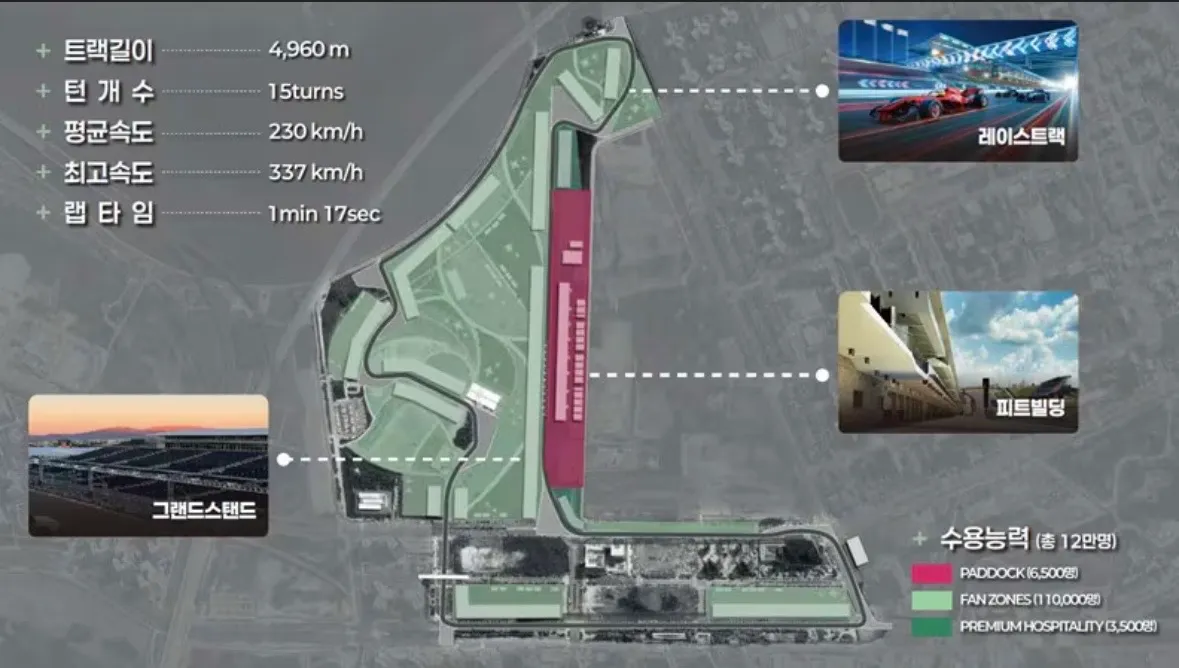
The Blueprint for 2028: Official technical layout of the 4.96km Incheon Street Circuit, designed by Tilke to meet FIA Grade 1 standards with a 337 km/h top speed.
Incheon 2028: The Redemption Arc of Korean Motorsport
by Vera Von Monika
On April 16, 2026, Incheon Mayor Yoo Jeong-bok confirmed what much of the industry had been tracking with measured caution: the Incheon Formula 1 Grand Prix project has cleared its preliminary feasibility study. With a Benefit-Cost (B/C) ratio of 1.45, the proposal moves beyond political projection and into technical viability.
For a country still defined, in motorsport terms, by the collapse of Yeongam, this is not simply a return.
It is a recalibration.
But recalibration is not resolution. The structure is stronger. The outcome is not yet secured.
Technical Geometry: Built for the 2026 Power Units
The proposed 4.96 km Songdo street circuit is not conceptual—it is responsive. Developed in collaboration with Tilke Engineers & Architects and the Korea Industrial Development Research Institute, the 15-turn layout is engineered around the demands of Formula 1’s 2026 regulations.
That alignment matters.
With a near 50/50 power split between internal combustion and a 350kW electric system, the next generation of Formula 1 cars will be defined as much by energy deployment strategy as by mechanical grip. Incheon’s layout - wide, high-speed, and structured around three primary acceleration zones - appears designed to exploit exactly that.
This is not a ceremonial street circuit.
It is a technical environment.
A consistent 12-meter track width and high-grip urban resurfacing position the circuit within FIA Grade 1 parameters, while projected top speeds of 337 km/h suggest a configuration that prioritizes flow over constraint. Around Songdo Moonlight Festival Park, the geometry becomes less about spectacle and more about system expression—how efficiently a car can harvest, store, and deploy energy across a lap.
Solving the Accessibility Gap
Yeongam failed structurally, not technically.
Its isolation - geographic and economic - turned a global event into a logistical burden. Incheon addresses that failure directly. Located minutes from Incheon International Airport and integrated into existing subway infrastructure, the Songdo model replaces remoteness with proximity.
This is not an aesthetic choice.
It is an operational correction.
By embedding the event within an urban system, the project aligns with a broader motorsport reality: accessibility defines sustainability. Infrastructure already exists. Audience friction is reduced. The event becomes participatory rather than observational.
Where Yeongam required travel, Incheon offers arrival.
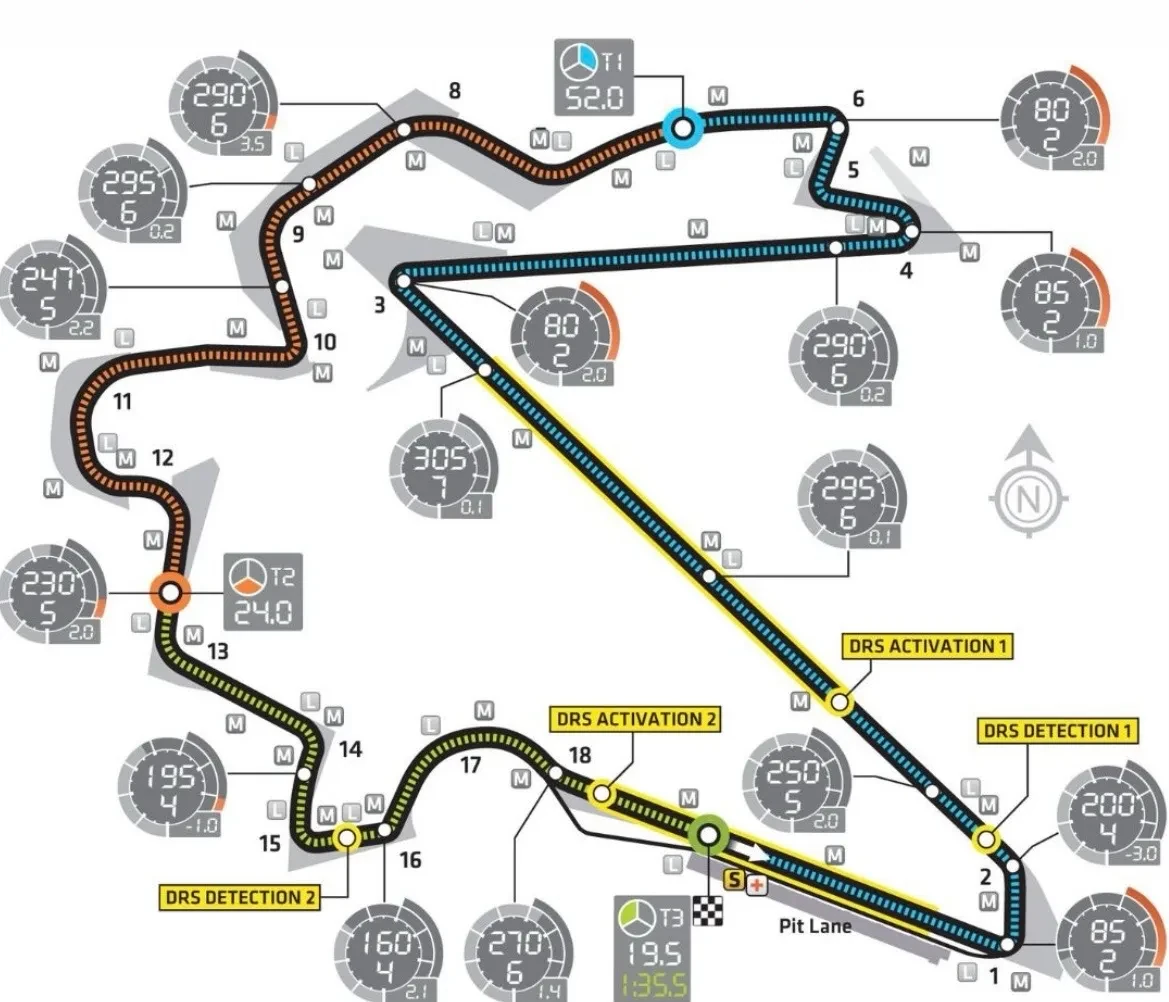
The Ghost of Yeongam: A technical retrospective of the original Korea International Circuit (2010–2013). My analysis positions the Incheon 2028 project as a deliberate structural shift away from this isolated permanent-track model toward an urban-integrated future.
The K-Culture Alignment & Private-Sector Pivot
The most consequential shift lies not in the circuit, but in the financing model.
The city’s move toward a private-sector-led structure - with a formal call for operators expected - signals an attempt to reframe Formula 1 as an economic platform rather than a public liability. The ambition is explicit: an urban festival capable of drawing up to 400,000 visitors through the integration of racing, music, and global cultural programming.
This is not simply event design.
It is brand construction.
By aligning with the export power of K-culture, Incheon positions the Grand Prix as part of a broader lifestyle economy, one that extends beyond the race weekend itself.
But this model introduces its own tension.
Private capital rarely enters without protection. The risk is not theoretical: investors may seek guarantees, subsidies, or revenue backstops that reintroduce public exposure under a different structure. The distinction between genuine private investment and publicly insulated capital will determine whether this pivot represents evolution - or rebranding.
The Headwinds Worth Naming
There are three constraints that cannot be abstracted away.
First, the feasibility study itself. The involvement of Tilke Engineers & Architects in its production introduces an inherent conflict of interest. A B/C ratio of 1.45 is directionally strong, but without independent verification, it remains provisional, not definitive.
Second, there is no confirmed agreement with Formula 1 management. The 2028 target is an objective, not a secured calendar position. In a championship increasingly selective about venue allocation, municipal readiness does not equate to contractual inclusion.
Third, the political variable.
With local elections scheduled for June 3, the project sits within an active electoral context. Opposition voices have already questioned its projected benefits. A shift in leadership could slow, reshape, or re-evaluate the initiative entirely.
Momentum, at this stage, is conditional.
Conclusion: A System, Not a Statement
What Incheon represents is not ambition, but adjustment.
The project replaces isolation with integration, spectacle with structure, and symbolic investment with measured alignment. The accessibility model is sound. The cultural positioning is differentiated. The technical framework is coherent.
But coherence does not guarantee execution.
Between now and the projected 2028 debut lies a sequence of validations: political continuity, independent financial scrutiny, private-sector commitment, and formal agreement with Formula 1 itself. Each is a gate, not a formality.
Incheon is not simply bidding for a race.
It is proposing a new operating model for what a modern Grand Prix can be.
Whether that model holds will depend not on vision, but on discipline.
And that distinction - between projection and delivery - is where this story will ultimately be decided.
 @vera.von.monika
 @veravonmonika
 Livedoor