Hwan Jae Jung (Julian): Inside CJ Superrace, Radical SR1 and the Evolution of Korean Motorsport
Within the structure of Korean circuit racing, where categories like the CJ Superrace Championshipand Radical Cup Korea function as both competitive platforms and developmental systems, drivers are increasingly defined not only by results, but by how they position themselves within a rapidly evolving motorsport landscape.
Hwan Jae Jung — known in the paddock as Julian — represents a profile that sits precisely within that transition. Competing in the Radical SR1 class, his trajectory reflects a shift toward drivers who balance technical discipline, data-driven preparation, and a broader awareness of the sport’s structural growth within the global racing ecosystem. Image via Hwan Jae Jung (Julian) In this interview, Julian approaches racing less as isolated performance and more as a continuous system: from the sensory demands of open-cockpit machinery to the strategic compression of qualifying, from identity within the paddock to the role drivers now play in shaping visibility and narrative around Korean motorsport. You have established yourself within the Radical Cup Korea SR1 class. What is it about the open-cockpit Radical that demands more from a driver than a traditional touring car, and how does that difference manifest from inside the cockpit? The Radical SR1 is not simply a fast car, but a machine that fully exposes all of a driver’s senses.
Competing at the top level of the CJ Superrace Championship, how has the current level of competition reshaped your approach to qualifying this season? The level of competition in CJ Superrace has definitely become much more intense compared to before.
As circuits evolve toward more technical layouts, which section of tracks like Everland Speedway or KIC most consistently tests your mental precision, and why? At both Everland Speedway and KIC, rather than a single corner, maintaining rhythm through consecutive sections is the most difficult part.
Following your pre-season work with Radical Korea, what has been the most significant technical adjustment in your driving approach, and what prompted that change? The biggest change through the pre-season was not about driving faster, but about driving fast in a more stable way.
In late-race situations, where decisions compress into fractions of a second, how do you balance the immediacy of an overtake with the discipline of overall race strategy? The final stages of a race are always moments of decision.
Within the paddock, you are known as “Julian.” Does that identity represent a separation from yourself or does the distinction disappear once you are in the car? 'Julian' is a persona created by myself and my younger brother Joseph, who both dreamed of racing.
What element of your preparation - physical, technical, or simulator-based —remains largely unseen, yet is critical to your performance on race day? The most important yet often unseen element is ultimately seat time. If supported by data analysis and repeated simulation, sufficient seat time eventually leads to good results.
With an established presence in domestic competition, which international endurance events or circuits define your next step, and why those specifically? I will continue competing as an SR1 driver this year, and aim to move to SR3 next year, followed by participation in the Ferrari Challenge. I hope so. I maintain a good relationship with Ferrari Korea, and I have been invited to attend the LUCE global launch event, as well as having contracted a limited-edition model which I am currently waiting for. My goal is to grow both internally and externally to become a driver capable of delivering competitive performance.
As Korean motorsport continues to develop, what specific structural shift is still required for CJ Superrace to achieve greater international visibility, and where do drivers position themselves within that process? For Korean motorsport to grow globally, I believe the development of domestic fan culture is essential.
Beyond results, which specific metric - performance, consistency, or data - will define this season as a success from your perspective? In the past, I believed that only becoming the season champion defined success.
“A good driver is not simply a fast driver, but someone who knows when to attack and when to wait.” — Julian
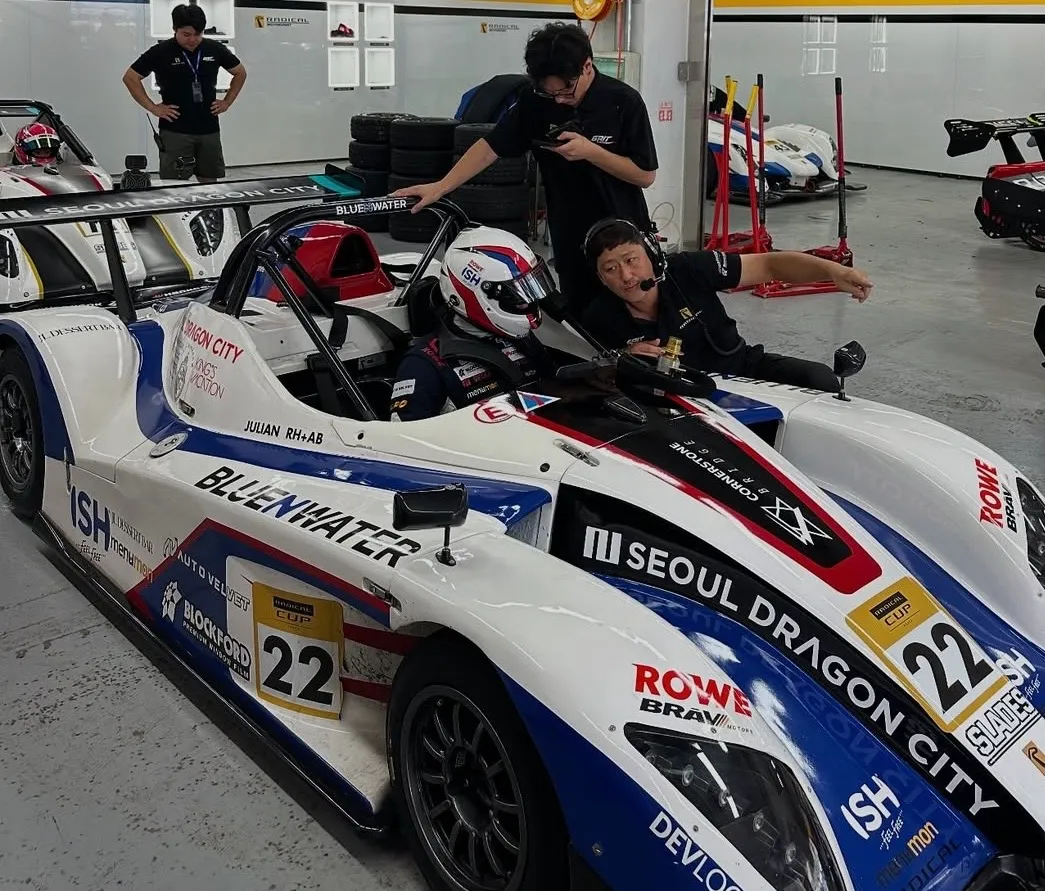
The open-cockpit structure provides a wide field of vision, but at the same time, airflow, temperature, tire condition, and track surface changes are all felt much more directly by the body. If a touring car plays a certain role in buffering the driver, the Radical delivers the driver’s input directly into the result, which requires a much higher level of precision and consistency.
Ultimately, I believe this car tests how well a driver can maintain focus and refine their senses, rather than just technical skill.
Especially in qualifying, it is no longer just about producing a fast lap, but about executing a single opportunity perfectly.
This season, I am focusing less on the best lap itself, and more on three key elements: the peak timing of the tires, track entry temperature, and traffic management.
In the end, I believe qualifying is not about pure speed, but about timing and completeness.
Especially in sections where a high-speed corner transitions into a low-speed corner, braking points and traction must be managed at the same time, and even a very small mistake can affect the entire lap time.
This section requires not just technical ability, but a high level of mental focus and precision in judgment. Personally, I prefer Inje Speedium the most. Its FIA Grade 2 level of difficulty, significant elevation changes, and the precision required in the high-speed sections connected to technical corners make it a very attractive circuit.
Rather than simply pushing for faster lap times while reducing mistakes, I focused more on maintaining stable race management.
In the past, I focused on aggressive driving, but now I have shifted toward managing tires and considering the overall race flow.
This change came from the realization that achieving results requires sustainable performance.
While it is important to take an overtaking opportunity when it appears, it is even more important not to compromise the overall race strategy. I always make decisions based on the perspective of “not just this one moment, but the entire race.”
In the end, I believe a good driver is not simply a fast driver, but someone who knows when to attack and when to wait.
Additionally, I personally believe that the start phase of the race is extremely important. In the rolling start format of Radical Cup Korea, the beginning of the race often directly influences the final result.
The Julian that my daughter Milanee and my wife Susan see is quite different, but the Julian in the racing paddock is someone who wants to inspire those who dream of motorsport. That is why I try to pay more attention to the children who come to watch Superrace events. To me, the name Julian is not simply another identity, but a direction — to become someone who can inspire the next generation of drivers on the track.
Radical Korea operates a highly structured program under the slogan “We make RACERS,” supported by data-driven analysis and driver briefings, and I believe this is one of the reasons many international drivers come to Korea.
In the future, I am also interested in endurance racing rather than only sprint races. I believe the European stage, where technical excellence, strategy, and teamwork are combined, provides an important opportunity for further growth as a driver.
In recent years, meaningful changes have been taking place around CJ Superrace, and public interest has been growing rapidly. Especially with the success of the film “F1 The Movie,” the F1 Mercedes team’s Peaches SHOW RUN event, and the growth of Radical Cup Korea, general public interest has increased significantly.
At this point, beyond the level of competition itself, I believe it is important to structure and deliver content and stories more effectively. Drivers should not be just participants, but also individuals who communicate their own stories. I believe communication through social media and media platforms is extremely important.
I also want to contribute to promoting Korean motorsport in that direction.
However, my perspective has changed.
For my wife Susan and my baby daughter Milanee, my race results are not the most important thing, and my younger brother Joseph, who is also my biggest supporter, always asks me whether I am enjoying the race.
In that sense, I believe I have already succeeded. As a driver competing in races, and as someone who continues this journey together with my beloved family, I believe I am already living something meaningful.
From now on, I want to create races that are more joyful and enjoyable.
 @vera.von.monika
 @veravonmonika
 Livedoor