Designing Empathy: Emotional Robotics and Japanese Aesthetics at Yukai Engineering
In an era dominated by automation, optimization, and artificial intelligence, Yukai Engineering stands apart by asking a quieter question: how should technology make us feel? Founded in Tokyo by Shunsuke Aoki, the studio has become internationally recognized for its emotionally responsive robots - objects that do not seek efficiency or authority, but presence, hesitation, and care.
Rather than designing machines that replace human action, Yukai Engineering creates companions that acknowledge human fragility. This philosophy has positioned Yukai at the forefront of what is now often called emotional robotics, while remaining deeply rooted in Japanese cultural sensibilities such as ma(間), iyashi (癒し), and measuredness.
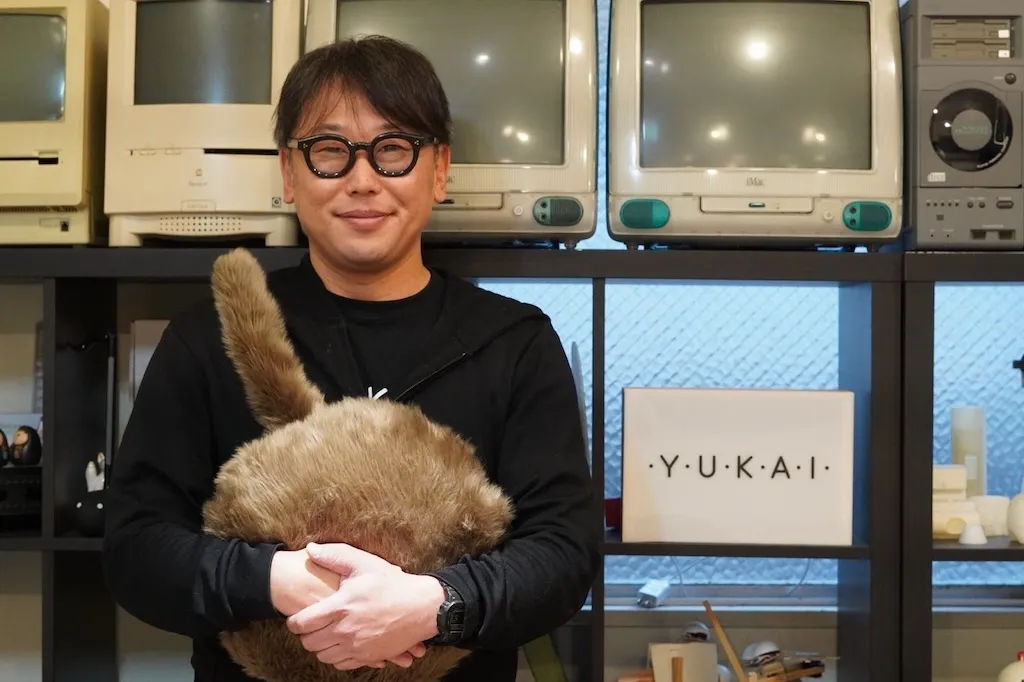
In this interview, founder and CEO Shunsuke Aoki reflects on the origins of Yukai Engineering’s philosophy, the importance of cuteness as emotional infrastructure, and why the future of robotics may depend less on intelligence - and more on empathy.
Yukai Engineering often describes its mission as “making the world a more enjoyable place through robotics.” How did this philosophy take shape, and were there personal experiences that influenced it?
From the moment we founded Yukai Engineering, our driving passion has been to create a new standard for robots used in the home. When we thought about what kinds of robots would truly be needed in domestic spaces, we felt that emotional value - like that found in companion robots - would become essential.
If we think purely in terms of robots that help with household tasks, the most efficient and rational form inevitably becomes something very similar to conventional home appliances. Technologically speaking, modern appliances already contain enough sensors and intelligence to be called robots. However, no one feels affection for a washing machine or dishwasher, nor do they give them nicknames.
Rather than a future surrounded by countless impersonal machines that automate every chore, we believe a future where endearing robots exist as partners would make us happier. From this thinking, we propose the definition that “a robot is a machine that moves the human heart.”
To be honest, a large part of this is also driven by a very simple desire: I just want to live surrounded by cute things.
Most technologies prioritise efficiency and productivity. Why did you choose to design robots that respond emotionally rather than ones that simply perform tasks?
Our goal is to popularize home-use robots worldwide. We are not trying to create more task-performing appliances. What truly matters for the future of humanity is not increasing the number of appliances we own, but learning how to live better as human beings.
Rather than automating everything and stripping people of agency, we believe robots can support human emotions and encourage positive actions, like cheerleaders for everyday life. That is the role we envision.
When designing robots for the home, humanoid forms are not ideal. Humans are extremely sensitive to human-like shapes, and cultures around the world rarely place human-shaped objects in everyday living spaces. Life-sized mannequins or sculptures are simply unsettling when they are too close. The same may be why monkeys never became common household pets.
In contrast, humans can live comfortably with dogs and cats precisely because they look completely different from us. One could even say that animals commonly kept as pets have evolved in ways that humans find endearing. We believe there is much to learn from the design and behavior of these animals.
Your products often communicate through silence, subtle movement, or hesitation. Do you consider restraint and modesty a form of intelligence in design?
In our design process, we try to remove as many unnecessary functions and elements as possible so that people can enjoy the interaction itself in its simplest form. Of course, we love cute things and put great passion into making our products adorable. But rather than relying on superficial decorative cuteness, we focus on the cuteness of interaction itself. By doing so, we aim to create products that can be enjoyed across time, beyond trends.
Mirumi, in particular, seems to embody emotions like shyness and curiosity rather than functionality. What did you hope people would feel when encountering Mirumi?
Mirumi was inspired by the way a small baby clings to its mother, sometimes shyly looking down, sometimes curiously glancing around.
When you see such a baby on a train, people nearby often talk to them, make funny faces to elicit a smile, only to be ignored as the baby suddenly looks away. Yet, in those moments, the baby brings small happiness to everyone around.
Mirumi is a robot designed to bring that same kind of quiet joy to the people nearby.
Japanese culture values ma - the space between actions. How does this concept influence your interaction design and sense of timing?
By deliberately avoiding excessive explanation or expression and keeping interactions simple, we aim to stimulate the user’s imagination. Just like sound or scent, the human sense of touch has the power to awaken distant memories. Additionally, we do not want robots to become the central actors in interaction. The most important interactions for humans should always be with other humans; robots should never replace that.
Part of why being with dogs or cats is calming is that they are completely unconcerned with human societal anxieties. Just as we don’t necessarily want pets to speak human language, robots that stay close to people don’t need to be capable of doing everything. Simplicity can be enough.
As emotional robotics gains global attention, how do you balance preserving Japanese sensibilities while reaching international audiences?
We don’t consciously try to make “Japanese” products, but when we bring our work overseas, it is often described as very Japanese. This may stem from differences in how “cuteness” is perceived.
In Japan, there is the concept of iyashi (癒し). Broadly speaking, it overlaps with healing, but it more specifically refers to the warm, soothing feeling we experience when watching small or fragile beings earnestly living their lives.
This feeling also applies to wearing cute character goods or caring for digital pets. Our products are fundamentally inspired by this sense of iyashi. Among different forms of “cute,” we place particular importance on cuteness that can be conveyed without relying heavily on language or visuals — a kind of cuteness that transcends barriers.
In a society shaped by AI and automation, what role should emotionally supportive technology play in daily life?
There’s an interesting story from one of our users. We have a robot with smart-speaker functions designed for elderly users, and one family used it to remind their grandmother to take her medication.
Previously, when family members reminded her directly, she would become irritated and resist taking her medicine. But when the robot reminded her, she responded by saying, “What a clever robot, thank you” and took her medicine smoothly.
This experience showed us that robots can facilitate communication and help people feel more open and positive. As AI and sensor technologies advance and robots become better at understanding human behavior, I believe robots will increasingly take on the role of supportive partners in people’s lives.
Looking to the future, what excites you most about Yukai Engineering from the perspective of human experience rather than products?
We have consistently created cute robots that stay close to people. In Japan and much of Asia, owning or wearing cute things has long been accepted regardless of age or gender. In contrast, in Europe and the United States, such things were often seen as childish. Recently, however, we’ve felt that this perception is changing significantly. Seeing this shift makes us genuinely excited, as it suggests that the possibilities for our cute robots are expanding.
 @vera.von.monika
 @veravonmonika
 Livedoor